


When a dentist tells you a tooth needs treatment, one of the first questions that often comes up is simple: will this be a dental crown or filling?
For many patients, the difference is not obvious. Both are used to restore damaged teeth. Both can help protect your smile. Both are common treatments. But they are not interchangeable, and the best option usually depends on how much of the tooth is affected, where the damage is located, and how much strength the tooth still has left.
If you have ever wondered why one person gets a dental filling while another is told they need a dental crown, this guide can help make that decision easier to understand.
What a Dental Filling Does
A dental filling is generally used when the damaged area is smaller and the tooth still has enough healthy structure to remain strong after the decay or weakened portion is removed.
In simple terms, a dental filling repairs one part of the tooth. It does not cover the whole tooth. That is why fillings are often the first choice for smaller cavities, minor wear, or small areas of breakdown. They are conservative, practical, and usually completed in a single visit.
A modern composite dental filling also blends in with your natural tooth colour, which is one reason many patients prefer Tooth-Coloured Fillings for visible teeth or for areas where appearance matters.
What a Dental Crown Does
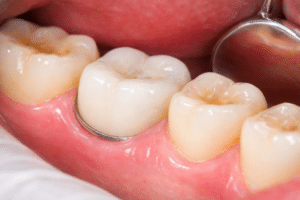
A dental crown is different because it covers and protects much more of the tooth. Think of a dental crown as reinforcement for a tooth that has lost too much structure to safely depend on a filling alone.
A dental crown may be recommended when a tooth has a very large cavity, an old large filling that is failing, a crack, or weakness after root canal treatment. In these situations, simply patching one portion of the tooth may not be enough to prevent further breakage.
That is where Crown & Bridge treatment comes in. A dental crown helps protect the tooth from heavier chewing forces and can reduce the risk of the tooth fracturing further.
Why Size Matters So Much
One of the biggest factors in the decision between a dental crown or filling is how much natural tooth remains.
A small to moderate cavity is often manageable with a dental filling. But when decay spreads across a larger portion of the tooth, the remaining walls can become thin and fragile. Even if a large filling is technically possible, it may not hold up well over time. The tooth could crack while chewing, especially on a molar.
This is one reason two cavities do not always get the same treatment. The location, depth, and overall strength of the tooth matter just as much as whether there is decay.
Real-Life Examples
Let’s say you have a small cavity between two teeth and the rest of the tooth is healthy. In that case, a dental filling is often the sensible option.
Now imagine a molar with a large old filling that has broken down, plus decay underneath. Even if the tooth is not causing severe pain yet, there may not be enough sound structure left to rely on another filling. A dental crown may be the safer long-term choice.
Another common situation is a cracked tooth. A filling may seal a small area, but if the tooth is already under strain, a dental crown often offers better support because it wraps around the tooth and helps hold it together.
Why the Cheapest Option Is Not Always the Most Cost-Effective
It is natural to hope a filling will be enough. Fillings are usually less involved and less expensive upfront. But the right answer to dental crown or filling is not always the smaller treatment.
If a tooth clearly needs more protection and only receives a filling, the result may not last. The tooth could chip again, develop deeper cracks, or eventually need more extensive treatment than it would have needed in the first place.
That does not mean a dental crown is automatically better. It simply means the best option is the one that matches the tooth’s actual condition.
Symptoms Do Not Always Tell the Full Story
A lot of people assume that if they are not in pain, the tooth cannot be that serious. Unfortunately, that is not always true.
Some large cavities cause very little discomfort at first. Some cracked teeth only bother you when biting on certain foods. Some old fillings fail slowly over time without obvious warning signs until a larger piece breaks off.
That is why diagnosis matters. The visible damage, the X-rays, the bite pattern, and the condition of the surrounding tooth all help determine whether a filling is still reasonable or whether a dental crown would offer a more stable result.
Questions Patients Often Ask
Can a filling turn into a crown later?
Yes. Many teeth start with fillings and later need crowns if more tooth structure is lost, the filling becomes too large, or the tooth weakens over time.
Does needing a crown mean the tooth is badly damaged?
Not always badly damaged, but usually damaged enough that more protection is needed than a filling can provide.
Can I wait?
Sometimes there is a short window where monitoring is possible, but waiting can also allow a tooth to weaken further. A tooth that might have been restorable with one treatment can become more complicated if it breaks or decay spreads deeper.
The Long-Term View
The decision between a dental crown or filling is not just about fixing today’s problem. It is about choosing the restoration that gives the tooth the best chance of staying functional and comfortable over time.
A well-placed dental filling can serve a tooth very well for years. A well-made dental crown can do the same when a tooth needs more coverage and strength. The key is using the right option for the right situation.
Final Thoughts
If you have been told you may need a dental crown or filling, it helps to think beyond the names of the treatments and ask a more useful question: how much support does this tooth really need?
That is usually what the recommendation comes down to. A smaller repair works well when the tooth is still strong. A dental crown becomes more appropriate when the tooth needs protection, not just patching.
For patients who want to understand their options clearly, the goal should never be to choose the biggest treatment or the smallest treatment. It should be to choose the treatment that gives the tooth the best chance of lasting well.
If you are deciding between a dental crown or filling, the most important thing is choosing the option that fits the condition of the tooth, not just the simplest-looking treatment.